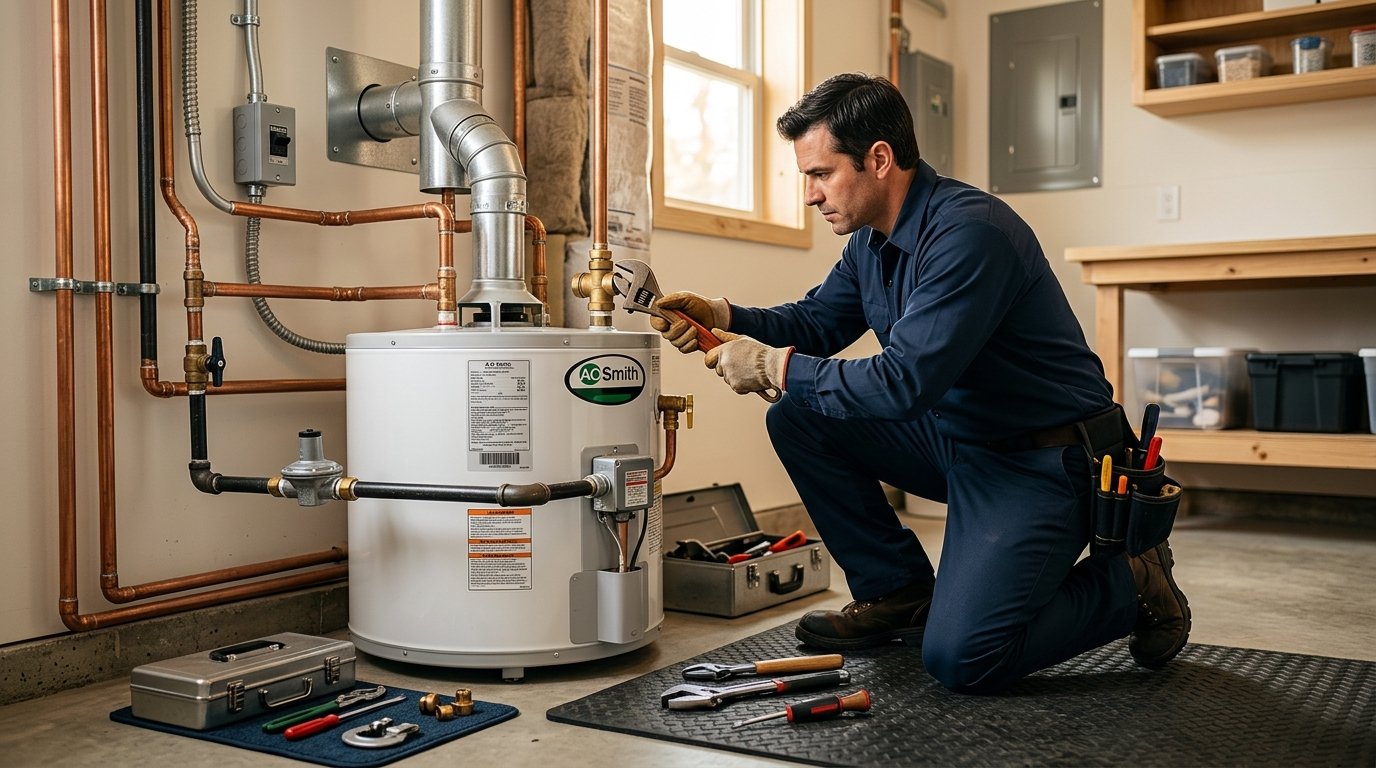
Critical Warning Signs Checklist
- Age Past 8–10 Years: Most residential tank water heaters have an average design life of 8 to 12 years in North Texas.
- Rusty Hot Water: Discolored water running only from hot taps indicates internal tank wall corrosion.
- Moisture Around the Base: Microscopic cracks in the inner steel vessel expand under heat and weep water.
- T&P Valve Weeping or Discharging (Sign #4): The primary safety relief valve is venting due to dangerous internal overpressure or tank failure.
- Diminishing Hot Water Volume: Cold showers after 5 minutes point to broken dip tubes or hardened sediment insulation.
- Persistent Clanking & Rumbling: Severe calcium buildup causing the tank floor to overheat and crack.
- Recurring Pilot Light & Control Lockouts: Internal burner and combustion chamber decay that costs more to patch than replace.
In suburban developments throughout North Texas, recognizing early warning signs of tank corrosion protects your home. Catching subtle symptoms before catastrophic ruptures damage sheetrock and living spaces saves thousands in emergency restoration costs.
In North Texas, a water heater failure is rarely a quiet inconvenience. In suburban developments throughout the area, many homes were built with water heaters installed in second-story attics. When an attic water heater ruptures, 50 gallons of scalding water plus continuous pressurized city water can cascade through drywall ceilings, ruining flooring, furniture, and family heirlooms in minutes. Recognizing the early warning indicators allows you to replace the appliance on your terms. The diagnostic specialists at Rowlett water heater inspection team provide same-day diagnostics to inspect tanks before catastrophic leaks occur.
1. The Equipment Age Exceeds 8 to 10 Years
Even with conscientious maintenance, standard steel storage water heaters have a finite lifespan. In North Texas, where municipal water from Lake Lavon carries 8.8 to 9.6 grains per gallon of mineral hardness, tanks face steady internal corrosion. Learn how mineral deposits accelerate this deterioration in our North Texas hard water guide.
Most manufacturers provide warranties ranging from 6 to 10 years, which closely aligns with the expected life of the internal sacrificial anode rod and the glass tank lining. Once a water heater reaches 10 years of service, its risk of catastrophic vessel breach increases by more than 400%.
How to Decode Your Water Heater's Age
You can verify the exact manufacturing date by checking the rating sticker on the side of the tank. Find the Serial Number and use these manufacturer decoding patterns:
- Rheem / Ruud / Richmond: The first four numbers represent the month and year. For example, 0415A12345 indicates April 2015.
- A.O. Smith / State / Reliance: Modern serial numbers use a two-digit year followed by a two-digit week. For example, 1624A01234 indicates the 24th week of 2016.
- Bradford White: Uses a two-letter year and month code. The first letter represents the year (e.g., G = 2010, H = 2011, J = 2012, K = 2013, L = 2014, M = 2015, N = 2016, P = 2017, R = 2018, S = 2019, T = 2020), and the second letter represents the month (A = Jan, B = Feb, etc.).
2. Rusty or Amber-Discolored Hot Water
If rusty, brownish, or metallic-smelling water pours from your faucets, internal oxidation is occurring somewhere in your plumbing. To determine whether the water heater is the culprit, perform this simple diagnostic test:
- Run the cold water tap at your bathtub for two minutes. If the cold water runs crystal clear, the incoming municipal supply and your main pipes are clean.
- Immediately switch to the hot water tap. If the water runs reddish, amber, or cloudy with black flakes, the corrosion is originating inside your hot water tank.
Water heaters are equipped with a sacrificial anode rod (made of magnesium or aluminum) that attracts corrosive elements to protect the steel tank. Our annual water heater maintenance includes inspecting and replacing anode rods before rust can attack the tank shell. Once the rod dissolves completely, aggressive minerals eat into the steel walls, and a leak becomes inevitable.
When evaluating whether rusty hot water stems from galvanized nipples or internal tank breakdown, call the team at Rowlett water heaters for an endoscopic inspection.
3. Moisture, Weeping, or Water Pooling Around the Base
Finding standing water or dampness around the base of the tank is the most definitive physical sign of impending failure. A water heater consists of an inner steel cylinder surrounded by thick polyurethane foam insulation and an outer decorative metal jacket.
When the internal cylinder develops stress fractures or rust pinholes, water seeps into insulation. Internal vessel fractures cannot be patched, making turnkey water heater replacement mandatory.
4. The T&P Relief Valve Is Continuously Weeping (DON'T IGNORE THIS)
The Temperature & Pressure (T&P) relief valve is the single most critical safety mechanism on your water heater. It is engineered to lift and vent water if the temperature exceeds 210°F or internal pressure climbs above 150 PSI, preventing the vessel from turning into an overpressurized boiler hazard.
If you notice water continuously dripping from the brass T&P valve or its connected discharge pipe, two dangerous conditions may be occurring:
- Failed Safety Mechanism: Mineral scale has coated the valve spring, preventing it from seating tightly.
- Thermal Runaway / Overpressure: The thermostat has failed and the burner is heating uncontrollably, or your thermal expansion tank has ruptured, forcing line pressure above safe operating limits.
Never plug, cap, or clamp a weeping T&P valve. Doing so traps extreme pressure inside the tank with no escape route. If your T&P valve is venting or older than 8 years, contact our 24/7 team for immediate emergency water heater repair.
5. Diminishing Hot Water Volume and Lukewarm Showers
Does your family run out of hot water halfway through the second morning shower, even though the system used to support four consecutive showers easily? Diminishing hot water capacity points to internal mechanical degradation:
- Broken Dip Tube: The cold water dip tube is a plastic pipe that directs incoming cold water straight to the bottom of the tank for heating. Over 8 to 12 years, the plastic degrades and snaps off near the top. Incoming cold water now mixes directly with outgoing hot water at the top of the tank, delivering lukewarm water after just a few minutes of use.
- Burnt-Out Lower Element (Electric Units): Electric heaters rely on two heating elements. If the lower element burns out due to mineral encrustation, only the top third of the tank gets heated, reducing your hot water volume by nearly 70%. Our electric water heater repair technicians can test elements and restore full recovery.
- Massive Sediment Displacement: In severe cases, 20 to 40 pounds of mineral sludge can occupy the bottom 10 to 15 gallons of tank capacity, physically reducing the amount of water the tank can hold.
6. Loud Metallic Clanking, Rumbling, or Banging
When water heaters reach their final years in North Texas, the accumulation of calcium carbonate and magnesium forms a dense, hardened rock layer across the lower third of the tank. As the intense heat of the gas burner or lower element attempts to transfer energy through this mineral bedrock, extreme localized thermal pockets form. To diagnose these sounds in detail, read our water heater noise troubleshooting guide.
The steel tank floor expands unevenly, creating loud groaning, metallic clanking, and deep rumbling sounds. These continuous thermal stress cycles weaken the factory welds and cause the glass enamel lining to crack and flake away, exposing bare steel to rapid oxidation. Once persistent clanking cannot be cleared with a flush, the tank is structurally compromised.
7. Repeated Pilot Light Outages & Gas Control Faults
On gas water heaters, an occasional pilot light outage caused by a strong outdoor wind gust is normal. However, if you find yourself relighting the pilot light weekly, or if the electronic gas control valve displays a constant blinking error code, the combustion assembly is deteriorating:
- Compromised Flame Arrestor: Modern water heaters utilize sealed combustion chambers with Flame Arrestor screens. Over 8+ years, these screens choke on lint, pet hair, and dust, starving the burner of oxygen and tripping thermal cutoff switches.
- Corroded Burner Manifold: Rust flakes dropping from the decaying tank ceiling can foul the pilot orifice and burner ports, preventing clean ignition. Our gas water heater repair specialists can inspect your burner assembly and carbon monoxide venting safety.
The "Repair or Replace" Decision Matrix
When facing a water heater malfunction, use this plumber-approved decision guide to determine the most cost-effective path forward:
| Factor | Repair Is Appropriate | Replacement Recommended |
|---|---|---|
| Tank Age | Under 6 years old | 8+ years old (10+ years is urgent) |
| Location of Leak | Top flex lines, nipples, or drain valve | Inner tank bottom, seams, or outer jacket |
| Repair Frequency | First component failure | Second or third service call within 18 months |
| Installation Location | Garage or ground-level utility room | Second-story finished attic space |
| Energy Efficiency | Meets current efficiency goals | Seeking 25–40% utility savings or tankless upgrade |
The 50% Rule for Plumbing Equipment
In the plumbing industry, master technicians apply the 50% Rule: If a water heater is more than 50% through its expected lifespan (more than 5 to 6 years old) and the required repair exceeds 50% of the cost of a brand-new installation, replacing the entire unit is substantially smarter than investing money into a dying system.
Proactive Replacement Before Catastrophic Leaks
Replacing an aging unit on your own timeline eliminates panic. Our licensed master plumbers provide same-day installations for Sachse water heaters and across North Texas communities.
Most importantly, proactive replacement avoids emergency cleanup expenses and ruined sheetrock. If your water heater exhibits two or more of the warning signs above, contact the licensed team at Rowlett Hot Water Pros. We serve homeowners across Fate, Heath, Plano, Richardson, and all 19 North Texas service areas with same-day appointments.