Quick Comparison Overview
- Hot Water Delivery: Tankless provides continuous, endless hot water for sequential use; storage tanks provide high simultaneous flow until their 40–50 gallon reserve is exhausted.
- Expected Lifespan: Tankless units last 20 to 25+ years with modular replaceable parts; storage tanks average 8 to 12 years before requiring total replacement.
- Attic Weight Elimination: Tankless systems weigh only 40–60 lbs wall-mounted; traditional 50-gallon tanks exert 450+ lbs of dead weight over second-story drywall ceilings.
- The North Texas Winter Factor: Groundwater drops to 48°F in January, requiring a massive 72°F temperature rise that reduces a tankless unit's output flow rate (GPM).
- Maintenance Obligation: Tankless heat exchangers require mandatory annual vinegar descaling to survive North Texas mineral hardness.
When deciding between tankless and traditional tanks, North Texas families must evaluate peak morning fixture usage, natural gas line capacity, and energy efficiency goals to choose the right system.
Both technologies have evolved significantly over the past decade. While tankless manufacturers promise endless hot water and dramatic energy savings, storage tanks remain the tried-and-true workhorse of American residential plumbing. The right choice depends on your household size, peak morning hot water habits, available fuel infrastructure, and long-term residency plans. In this guide, our master plumbers cut through marketing claims to give you an objective, engineering-focused comparison.
1. Fundamental Mechanics: How Each System Operates
Traditional Storage Tank Heaters
A conventional water heater is a large, insulated steel cylinder that keeps 40, 50, or 75 gallons of water continuously heated to 120°F to 140°F. Whether you are sleeping at 3:00 AM or away on vacation, the heating source cycles on and off around the clock to compensate for heat escaping through the tank walls—a phenomenon known as standby thermal loss. Learn how gas and electric tanks compare in our electric vs. gas water heater guide.
When you take a shower, hot water is drawn from the top of the vessel while replacement cold water enters through a dip tube at the bottom. As long as water is consumed within the tank's volume, hot water pressure and temperature remain steady.
On-Demand Tankless Heaters
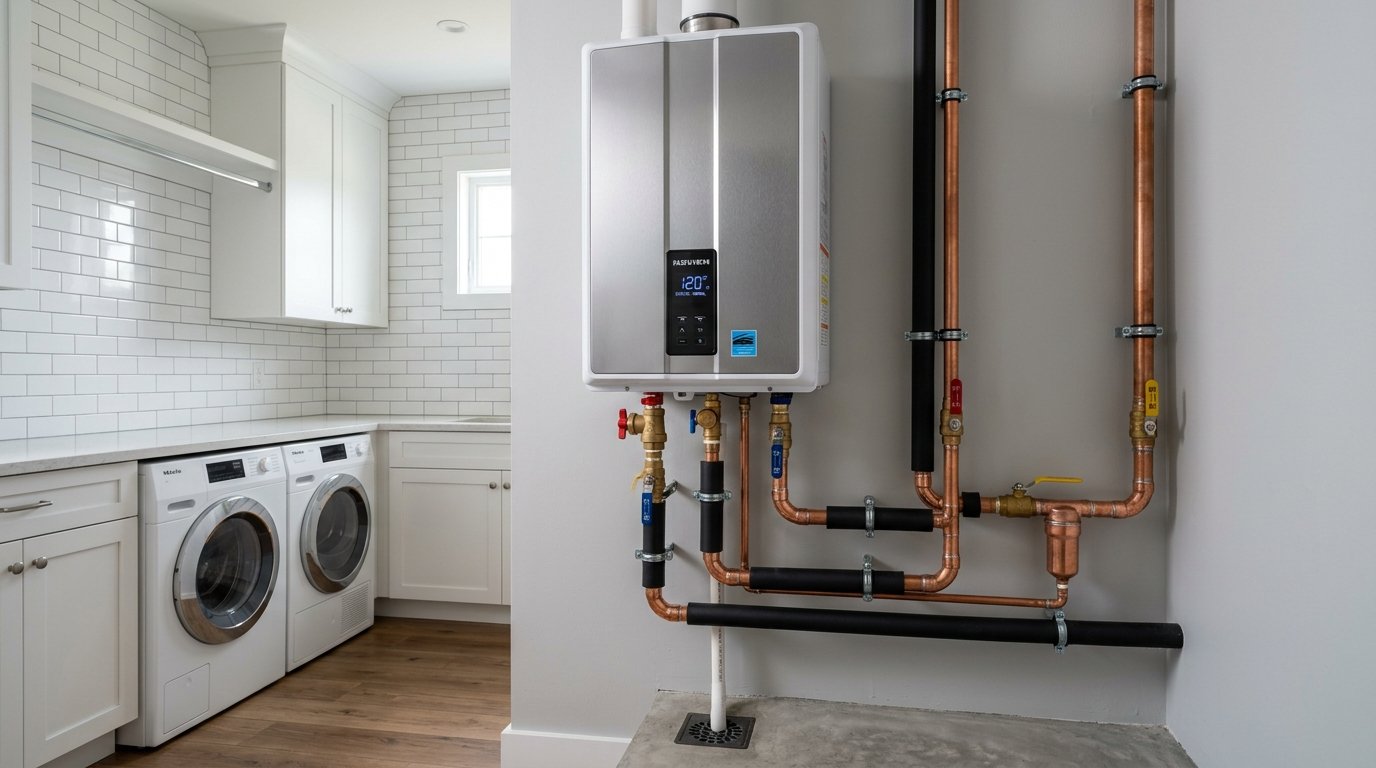
Tankless water heaters eliminate the storage reservoir entirely. When a hot water fixture is opened, an internal flow sensor detects water movement and instantly ignites a modulating high-output gas burner (up to 199,000 BTU) or activates dual electric heating elements. Water circulates through a high-efficiency copper or stainless steel heat exchanger, absorbing thermal energy in a single pass before exiting directly to your fixtures.
When the faucet closes, the unit shuts off completely, consuming zero standby energy.
For home energy audits and personalized return-on-investment payback timelines, homeowners rely on Rowlett water heaters to compare gas and electric unit efficiency.
2. Endless Hot Water vs. Peak Simultaneous Demand (The GPM Math)
The most publicized advantage of tankless water heating is "endless hot water." If you have teenagers who take 30-minute showers, or back-to-back guests visiting for the holidays, a tankless unit will never run out of hot water. The 50th minute of a shower will be just as hot as the first.
However, there is a crucial distinction between duration and volume:
- Storage Tanks Excel at Simultaneous Flow: A standard 50-gallon tank can supply hot water to three showers, a dishwasher, and a washing machine simultaneously without a sudden drop in water temperature—until the 50 gallons are depleted. Once empty, recovery takes 30 to 50 minutes.
- Tankless Heaters Excel at Continuous Flow: A tankless heater delivers hot water continuously, sized to your household needs from older ranch homes to modern residences without running out.
3. The North Texas Winter Groundwater Reality (Delta-T)
Many homeowners read manufacturer brochures boasting "10 Gallons Per Minute Flow Rate" and assume that performance applies year-round in Texas. In reality, a tankless water heater's output is governed by incoming groundwater temperature.
To deliver comfortable 120°F water, the unit must overcome the difference between the incoming water temperature and the target temperature—this difference is called Delta-T (ΔT).
- Texas Summer Conditions: Groundwater from Lake Ray Hubbard or Lake Lavon enters your home at approximately 75°F. To reach 120°F, the unit only needs a 45°F rise. Under these conditions, an 11 GPM tankless unit easily outputs its maximum rated volume.
- Texas Winter Conditions: In January and February, municipal groundwater temperatures drop to 48°F to 52°F. To reach 120°F, the heater must achieve an intensive 68°F to 72°F temperature rise. Under this heavy load, an 11 GPM unit's actual output drops to approximately 5.2 to 5.8 GPM.
In a larger suburban home with two simultaneous 2.5 GPM showers running in winter, a properly sized tankless unit will operate near its maximum capacity. Professional sizing by a licensed plumber who understands local winter groundwater dynamics is essential.
4. Equipment Lifespan and Long-Term Durability
A primary financial justification for converting to tankless is mechanical longevity:
- Storage Tanks (8 to 12 Years): Because steel tanks hold 50 gallons of corrosive, pressurized hot water continuously, internal welds and glass linings eventually degrade. Once the tank rusts through, explore our turnkey water heater replacement service.
- Tankless Systems (20 to 25+ Years): Tankless units are modular commercial-grade machines constructed with commercial-grade copper or marine-grade stainless steel heat exchangers. Every internal part—from electronic PC boards and water flow servos to burner igniters and sensors—is independently replaceable.
5. Space Savings and Eliminating Attic Water Hazards
In modern two-story homes throughout North Texas, builders frequently place 50-gallon water heaters in the attic to free up garage space. A full 50-gallon tank weighs approximately 450 to 500 pounds, suspended directly over drywall ceilings and living spaces. When an attic storage tank ruptures, catastrophic ceiling collapses and structural water damage can exceed tens of thousands of dollars.
A tankless heater mounts securely on a wall and delivers continuous flow. Our licensed master plumbers perform precision tankless heater installation including gas upsizing and direct venting.
6. North Texas Water Hardness and Maintenance Obligations
Hard water is the chief enemy of tankless water heaters. Water supplied across Rowlett and Collin/Dallas counties contains 8.8 to 9.6 grains per gallon of dissolved minerals. Read our full analysis of hard water and your water heater to understand mineral precipitation.
If an owner neglects maintenance, scale builds up in the narrow heat exchanger channels, triggering error codes like Navien E003 or Rinnai Code 11. Our team provides specialized tankless water heater repair and descaling to flush out calcium scale with food-grade virgin vinegar and restore factory flow.
7. Infrastructure Requirements for Tankless Conversion
Converting from an atmospheric storage tank to a high-efficiency tankless system requires three critical infrastructure upgrades that must comply with local Texas plumbing codes:
- Gas Supply Line Sizing: A standard 50-gallon gas tank consumes 40,000 BTU/hr, served by a 1/2-inch gas pipe. A whole-home tankless unit demands between 160,000 and 199,000 BTU/hr—nearly five times the fuel. Most installations require upsizing the gas branch line to 3/4-inch or 1-inch, handled directly by our certified gas plumbers.
- Direct Venting: Modern condensing tankless units operate at 95%+ thermal efficiency, producing acidic, low-temperature exhaust gases that cannot vent through standard metal chimneys. They require dedicated 2-inch or 3-inch PVC, CPVC, or polypropylene pipe vented through a sidewall or roof.
- Electrical Outlet: Unlike standard atmospheric gas tanks that operate without electricity, tankless units require an adjacent 120V electrical outlet to power electronic ignition, circuit boards, and internal freeze-protection heating ceramic pads.
Head-to-Head Comparison Matrix
| Feature / Metric | Traditional Storage Tank | On-Demand Tankless Unit |
|---|---|---|
| Hot Water Delivery | Finite capacity (40–50 Gal reserve) | Continuous & endless supply |
| Simultaneous Outlets | High (limited only by pipe diameter) | Moderate (governed by GPM & winter ΔT) |
| Expected Lifespan | 8 to 12 Years | 20 to 25+ Years |
| Physical Footprint | Large cylinder (approx. 22" × 60") | Compact wall-hung (approx. 18" × 28") |
| Weight When Full | 450 to 550 lbs | 40 to 65 lbs |
| Standby Heat Loss | Continuous (re-heats 24/7) | Zero standby energy loss |
| Annual Energy Savings | Baseline standard | Approximately 25% to 35% less gas |
| Required Maintenance | Annual sediment flush | Annual chemical descaling flush |
| Freeze Outage Operation | Standard gas models run with no power | Requires battery backup or generator |
Which System Wins for Your Home?
Choose a Tankless System If:
- You have a busy household with high hot water consumption and back-to-back morning routines.
- You want to eliminate 500 lbs of standing water from your second-story attic.
- You plan to stay in your home for at least 7 to 10+ years to maximize long-term equipment ROI.
- You have adequate gas infrastructure (3/4-inch line) or are willing to upgrade it.
- You are committed to scheduling annual descaling maintenance.
Choose a High-Efficiency Storage Tank If:
- You want the most straightforward, lowest-friction same-day replacement.
- Your existing home infrastructure cannot easily accommodate a 3/4-inch gas line or new direct-vent routing.
- You plan to sell or move within the next 3 to 5 years.
- You prefer an appliance with fewer electronic microprocessors and lower sensitivity to hard water minerals.
Need help determining the exact hot water flow rate and gas capacity of your home? Contact Rowlett Hot Water Pros or consult our team for Heath tankless upgrades to speak directly with a licensed Texas master plumber. We provide honest, on-site mechanical assessments across Heath, Fate, Lucas, and all 19 DFW service territories to recommend the ideal solution for your budget.